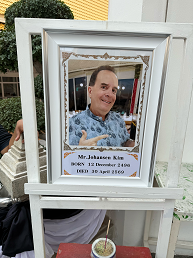
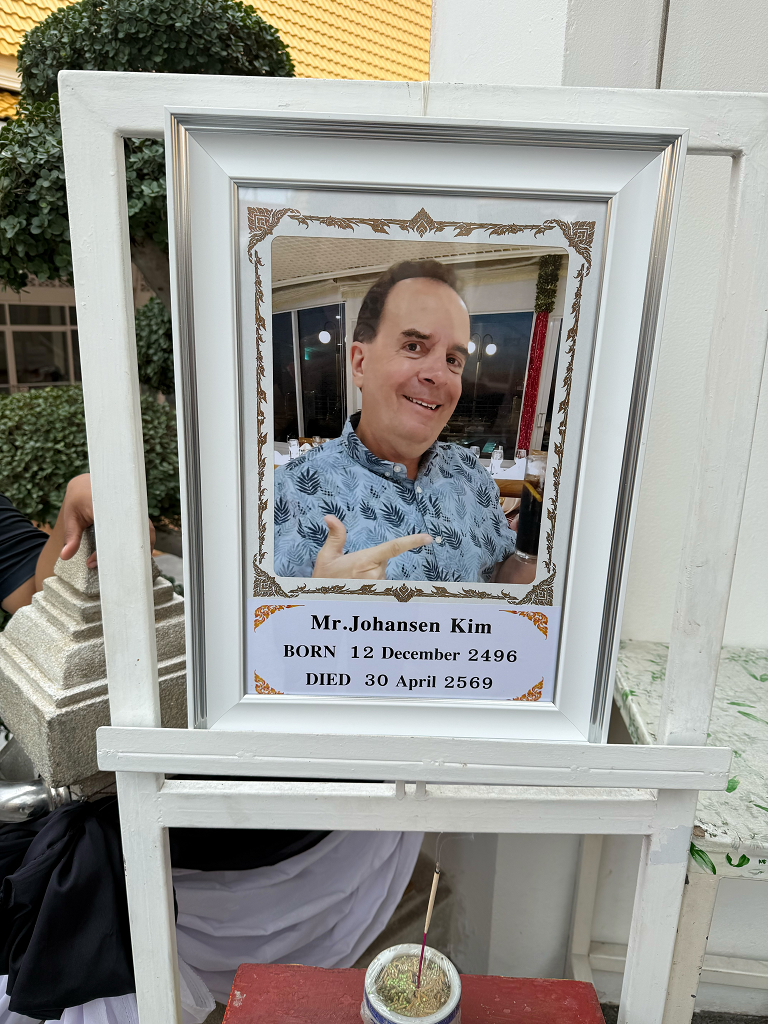
Kim Johansen, my closest friend in Thailand, died last month. He was 73. Dengue fever, which he seemed to be recovering from, was followed by a long and miserable slide caused by a cocktail of medications that wrecked his sleep and his mental health. He went quietly in his sleep in the end, which is as good an exit as most of us can hope for.
Kim was one of the pillars of my life here. Two of those pillars are now gone in five years. If you’ve been reading this blog long enough you’ll know who the other one was.
I’ll be honest — and this is something I don’t say lightly — in the immediate aftermath I found myself asking what the point of it all was. That’s not a comfortable place for me to be. But it was real, and I’m not going to pretend otherwise. What pulled me out of it, faster than anything else, was the absolute certainty that Kim — and Mark — would have had precisely zero patience with that attitude. I can hear them both, very clearly. So I got on with it. 😊
Kim’s death has left a few practical problems in its wake, as deaths tend to do.
He was the landlord of my condo, and he left it to a young Cambodian man who was part of his extended family here. The young man has no interest in owning property in Thailand, so he’s selling. Which means I have an unexpected 5 million baht expenditure sitting on my horizon.
I’ve never been a fan of owning property. It ties you down and creates obligations. But in this case the logic is fairly clear: I renovated this condo. I know every inch of it. I’m happier here than I have been anywhere I’ve lived in my life. If it sells to a stranger there are no guarantees — the rent could go up, they might want to use it themselves, anything. Buying it is simply the most practical option. So I’m buying it. It’ll take a few months yet — paperwork in Thailand moves at its own speed, and the executor needs to get the legal ducks in a row before a sale can happen. But it’s happening.
Speaking of executors — Kim’s estate has revealed some interesting gaps. His executor is also my executor, and we’ve been talking through the process together. I’ve been reviewing my own instructions and finding holes I didn’t know were there. Things Kim hadn’t accounted for, and neither had I. I’m rewriting those instructions now. If you’re an expat living abroad — especially in Asia — and you don’t have airtight executor instructions, I’d strongly suggest you revisit that. You probably have the same gaps.
I’ve been told that when the police arrived at Kim’s home, they required the occupants to open the safe and took away documents, passports, and his wallet. I understand that any cash had already been removed, but I wasn’t happy about any of this. Copies of documents — fine, I understand that. But originals? Wallet? Credit cards? What possible reason could they have to take those?
I spoke with a local lawyer about it. Apparently they do have the legal right to remove papers and valuables. They are required to return them eventually, though “eventually” can mean a while. The lawyer’s advice — with considerable subtext — was to find a way to conceal things so they won’t have access in the first place. Which is what I’m now planning.
How tragic that one has to plan for this.
The same week, one of my business partners also died. We weren’t close — he had become a difficult recluse in very poor health, and his illness had made him essentially impossible to be around. From what I heard, he was diagnosed with gangrene from diabetic complications, refused amputation, discharged himself from hospital, and was dead within a week. It’s a terrible way to go. And a reminder — not that I needed one at this point in the month — of how important it is not to let yourself get to a place where there’s nobody around who can help you.
I don’t want to go that way.
In the two weeks since I originally wrote the draft of this post, my back has greatly improved. I’m regularly consulting with Dr. ChatGPT 😊, taking it easy, and this is better than I’ve felt in many months.
Thai is coming along. Slowly. Painfully slowly. But it’s coming.
And under the category of puttering — I managed to get my firewall duplicated onto a newer box, which means the older unit is now a warm backup. If you don’t know what that means: if my primary firewall fails, I can switch to the backup quickly rather than having to rebuild from scratch. Satisfying to have done.
My home network is, objectively, significantly more engineered than I actually need it to be — but it gives me something to tinker with and I’m not apologizing for that. 😊 The next step is upgrading the WiFi, and this is where having been a network engineer in a previous life comes in handy.
Most people who upgrade their home WiFi reach for a consumer mesh system — brands like Eero, Google Nest, or TP-Link Deco. These are multiple units placed around the home that talk to each other wirelessly to extend coverage. They’re easy to set up and work reasonably well for most households — particularly in countries like the US where homes are typically built with drywall and timber framing, which WiFi signals pass through without much trouble. The catch is that the wireless “backhaul” — the communication between the mesh units themselves — competes for the same airspace as your devices, which can eat into speed and introduce latency (delay). And in a country like Thailand, where virtually all construction is concrete and masonry, mesh systems have an additional problem: concrete is genuinely terrible for WiFi propagation. Signals weaken dramatically through thick concrete walls, the mesh units struggle to talk to each other reliably, and the whole system underperforms in exactly the conditions where you need it most.
What I’m doing instead is running physical ethernet cables from a central network switch to wireless access points (APs) mounted on the ceiling. Each AP gets its own dedicated wired connection, so it’s operating at full speed with no wireless overhead. The result is faster, lower latency, and considerably more reliable — especially in a concrete building like mine where wireless signals already have to fight their way through walls. It’s more work to set up, but the performance difference is meaningful. I’m going with Ubiquiti hardware, which is a professional-grade brand that happens to also be manageable by an enthusiastic amateur. Not strictly necessary for a single condo. But it’ll be better, and sometimes better is enough of a reason.
Kim’s death has reminded me, sharply, to stay in better contact with the people I care about. That’s easy to say and harder to actually do. I’m working on it.
I called Michael in the UK yesterday. Hip replacement in his 90s, but doing well. So good to talk to him. One of the best and kindest people I know, and I am honored to count him among my closest friends.
Miss you, Kim.
0 Comments